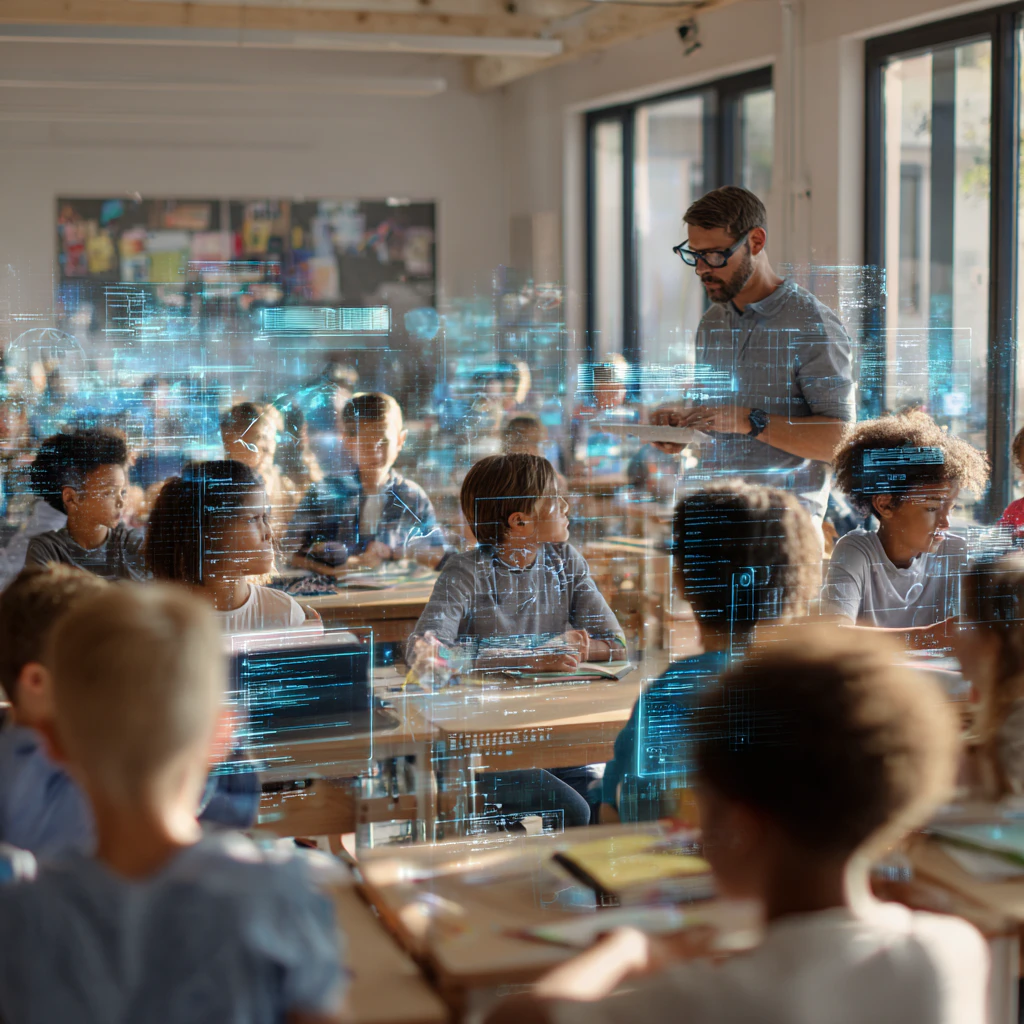
This gap between promise and practice is a central theme in episode 38 of AI Experience with Jeff Riley, where we explore how AI in education may finally make personalization operational inside classrooms.
Why personalization has always failed in practice
In traditional classrooms, teachers are constrained by time, class size, and curriculum demands. This is why, for most of the last century, personalization at scale was essentially out of reach: there were simply not enough hours in the day.
Recent research shows that a significant portion of a teacher’s workday is taken up by tasks that are not direct instruction. According to OECD analysis, between 20 % and 40 % of teachers’ time is spent on activities that could be automated (McKinsey, 2020), such as preparing materials or managing routine tasks. This leaves limited capacity for differentiated instruction or personalized learning.
Differentiated instruction has long been a core concept in teacher education. Yet implementing it consistently across classes with 20-30 students, each with unique strengths and needs, demands time and resources that most systems have not provided.
Attempts to use education technology before AI often failed because the tools added complexity or required manual setup from teachers, rather than reducing workload. As a result, personalization remained an ideal, not a daily reality.

Join the list

Abonnez-vous
What personalization at scale really means (and what it doesn’t)
To understand personalization at scale, it helps to separate it from related concepts that have different implications:• Tracking groups students by ability permanently, which can reinforce inequality.• Individualization replaces group learning with solo tracks, which isolates learners.• Personalization at scale, by contrast, adjusts how students engage with the same content—through different entry points and supports—while preserving shared learning experiences.
This distinction matters because personalized learning at scale is not about pulling students apart but about making instruction more responsive within the classroom.
Personalization at scale implies teachers can offer multiple pathways through the same lesson. For example, students may receive texts rewritten at different reading levels, alternative examples targeting specific misconceptions, or varied practice questions tailored to their progress. AI tools can generate these adaptations instantly, enabling differentiated instruction that once required hours of manual preparation.
This approach preserves peer learning while ensuring artificial intelligence in schools supports deeper engagement, not segregation.
How AI changes the economics of personalization
Artificial intelligence in education reduces the time and effort needed to create personalized materials. Tasks like rewriting a text for multiple reading levels, generating examples, or designing scaffolds can be done with a prompt rather than hours of preparation.
As Jeff Riley states in the episode, “AI is going to allow teachers to change their practice, and in particular, to differentiate and personalize instruction in a way we never could before.” This quote underscores how AI for teachers shifts personalization from theory to practice by lowering operational barriers.
The real breakthrough lies in making personalization part of routine instruction rather than an add-on. AI doesn’t eliminate the need for professional judgment; it amplifies teacher capacity. Teachers can focus on feedback, discussion, and mentoring, tasks that research shows are strongly linked to student outcomes, while AI handles variability at scale.
Why this is a teaching transformation, not a tech story
There is a persistent myth that AI in education will replace teachers. The actual value, as discussed in the episode, lies in augmenting teacher practice. AI can process patterns and generate alternatives, but it cannot replace the relational and interpretive work of a teacher.
This aligns with findings from educational research showing that students benefit most when technology enhances, not replaces, human interaction. Personalization at scale only succeeds when teachers remain in the driver’s seat.
With administrative and repetitive tasks reduced, teachers can reclaim time for facilitation and mentoring—roles that algorithms cannot automate. This shift redefines the future of teaching: from content delivery to guiding interpretation, reasoning, and social learning.
This transformation of teacher responsibility is at the heart of why personalization at scale matters more than any specific tool.
When personalization can backfire
Personalization at scale can backfire if AI becomes a crutch rather than a support. Students may accept AI outputs uncritically, which weakens deep thinking and reasoning.
As Jeff Riley points out, “Many parents don’t understand how often AI is wrong… it’s subject to bias and can make up incorrect answers.” This observation highlights the importance of building AI literacy alongside integrating tools.
For personalization to be educationally meaningful, both students and teachers must understand the limits of AI. AI literacy enables users to evaluate outputs, question assumptions, and use tools intentionally rather than passively. Without this literacy, personalization can become personalization of error or convenience, rather than learning.
Personalization at scale is no longer an idealistic slogan. With thoughtful implementation of artificial intelligence in schools, it can become a concrete shift in daily practice. AI for teachers changes the economics of personalization, turning an operational impossibility into an instructional reality.
This nuanced perspective is developed in episode 38 of AI Experience with Jeff Riley, where we explore the limits and possibilities of personalization through AI. For a deeper look at how AI reshapes instruction—and what education must do to avoid its pitfalls—listen to the full episode.