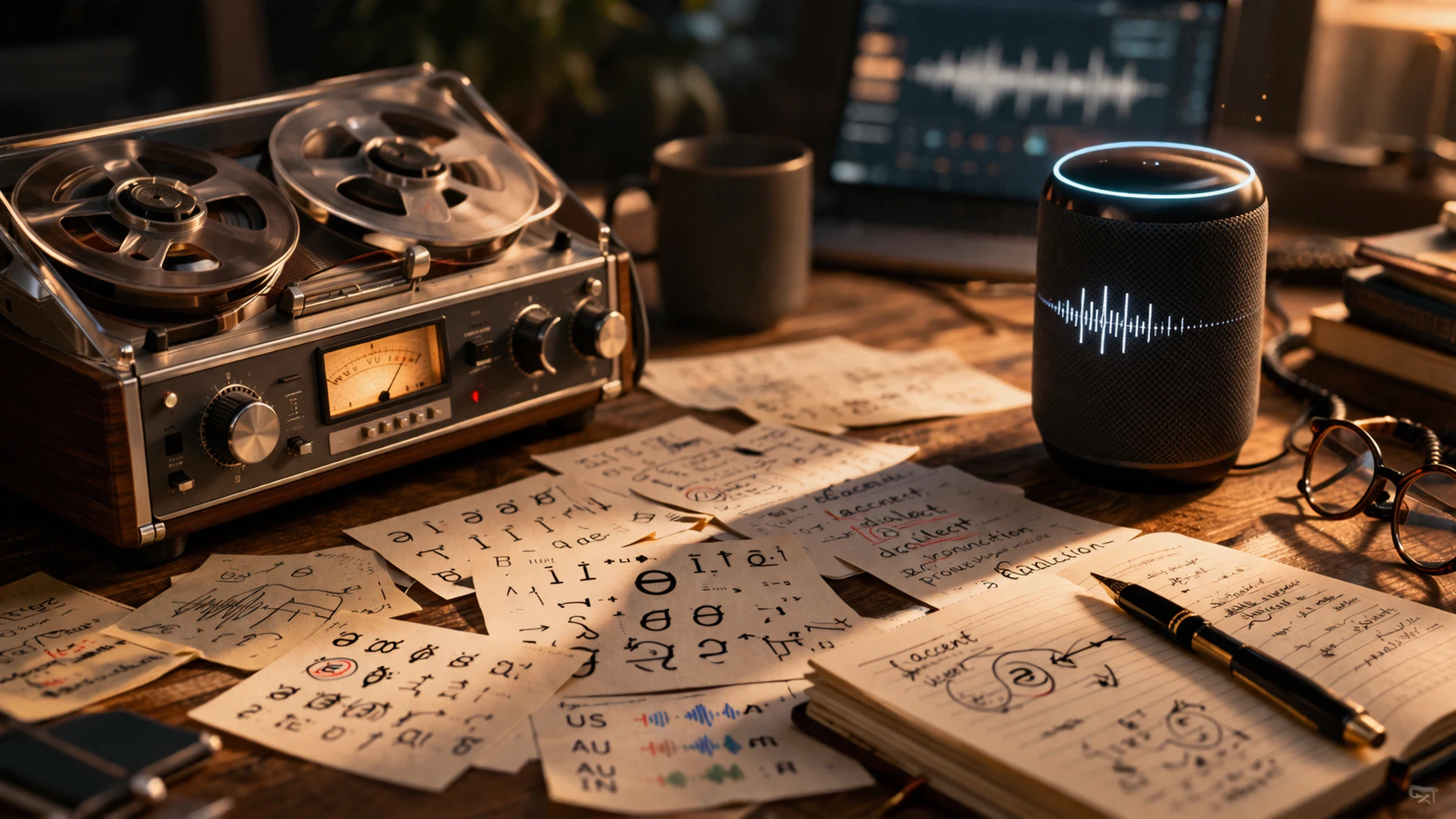
That is what makes this topic so important. In episode 74 of AI Experience, Julien Redelsperger speaks with Bonnie Sherriff on episode 41 of the AI Experience Podcast about the limits of voice AI, accent recognition, and the hidden risks of language bias in AI. Their conversation raises a larger question: if AI communication tools are increasingly deciding which voices are easy to understand, are they also deciding which voices matter?
Why AI tools are shaping language standards
Speech recognition, transcription, subtitles, voice assistants, and customer service bots are now part of daily life. These tools influence how people speak, what pronunciation they adopt, and even which accents they consider “professional.” This is not a minor issue. According to McKinsey, generative AI could increase productivity in customer care functions by 30% to 45%, which means more companies will rely on voice AI and automated communication systems in the coming years. As these tools become more common, they start to define what “good English” sounds like. In practice, that often means clear, slow, standardized English with minimal regional variation.
How speech recognition systems learn what “correct” English sounds like
Speech recognition bias often begins with training data. AI systems learn from millions of hours of recorded speech, but those recordings are rarely balanced across all accents, dialects, ages, or linguistic backgrounds. A major 2024 academic study found that speech recognition systems consistently perform worse for regional accents and non-native accents than for more “standard” speech patterns. The researchers concluded that accent recognition errors are not random mistakes but a structural bias built into the way models are trained. That means voice AI does not only struggle with unusual speech. It often struggles with perfectly valid forms of English that simply do not match the dominant accent patterns present in its training data.

Join the list

Abonnez-vous
Why “neutral” accents are often prioritized by AI
Many companies speak about “neutral” English, but neutral accents do not really exist. In most cases, so-called neutral English simply reflects the accent of a dominant social, geographic, or economic group. Voice AI systems are often optimized for mainstream American or British pronunciation because those accents are overrepresented in training datasets. This creates an uneven playing field for speakers with regional accents, immigrant accents, or non-native English pronunciation. In the podcast, Bonnie Sherriff explains this clearly:
“AI can support communication, but it still gets accents, dialects, and pronunciation wrong. That is why empathy and flexible listening still matter.”
This quote matters because it highlights the difference between efficiency and understanding. AI communication tools may process speech quickly, but they still fail when language becomes more complex, contextual, or culturally specific.
The growing influence of voice assistants, subtitles and transcription tools
Voice AI is no longer limited to smart speakers. It now powers subtitles in video meetings, transcriptions in podcasts, automated interviews, customer service chatbots, and even healthcare documentation. As these systems become more common, they influence how people adjust their speech. Many speakers simplify their pronunciation, slow down, or reduce their accent to avoid being misunderstood by AI. That creates a subtle but important form of pressure: people begin adapting to machines instead of machines adapting to people.
The problem with a single version of “good English”
The idea that there is only one acceptable version of English is both inaccurate and exclusionary. English is a global language spoken by people with different accents, dialects, cultural references, and speech patterns. Yet many AI communication tools still treat one version of English as the default and everything else as a deviation.
Why English accents and dialects vary so much
English has hundreds of regional forms. A speaker from Scotland, India, Nigeria, Texas, Australia, or Quebec may all speak fluent English while using very different pronunciation, rhythm, vocabulary, and sentence structure. These differences are not errors. They are natural forms of linguistic diversity. However, language bias in AI often treats diversity as noise. Research published in 2024 found that large language models default to standard English varieties and respond less accurately to non-standard dialects. Compared with standard English, responses to non-standard dialects showed more stereotyping, more misunderstanding, and more condescending language.
How AI can misunderstand regional accents and non-native speakers
Speech recognition bias affects people differently depending on how they speak. Studies published in 2025 found that automatic speech recognition systems still perform significantly worse when processing non-native English speech from speakers with Arabic, Chinese, Hindi, Korean, Spanish, or Vietnamese backgrounds. In practical terms, that means AI pronunciation tools, voice assistants, or transcription software may misunderstand certain speakers more often than others. In the episode, Bonnie Sherriff notes:
“Vocabulary, accents, and dialects are still evolving. AI is a useful starting point, not a perfect solution.”
This quote is important because it reframes voice AI as a support tool rather than a final authority. It reminds readers that language is constantly changing and cannot be reduced to one correct model.
The hidden risk of reinforcing accent discrimination
Accent discrimination already exists in hiring, education, and public life. AI can make this problem worse if companies rely too heavily on automated systems without testing for accent recognition issues. Recent Harvard Business Review research found that accents can affect how much attention people receive, how credible they appear, and whether their ideas are remembered. Separate academic research published in 2024 also found that people tend to perceive statements as less credible when they are delivered with a foreign accent, even when the content is identical. If AI systems are trained on these same biases, they risk reproducing them at scale.
Speech recognition bias is not just a technical issue
Many organizations still see accent recognition as a product issue rather than a business issue. That is a mistake. When voice AI misunderstands people, the consequences can be operational, financial, and reputational.
How pronunciation errors affect customer service, education and healthcare
In customer service, an AI assistant that cannot understand a caller’s accent creates frustration, longer calls, and lower satisfaction. In education, speech recognition bias can affect automated grading tools, transcription software, or language learning apps. In healthcare, inaccurate transcriptions can create mistakes in patient records or misunderstandings during consultations. Researchers increasingly warn that these errors are especially dangerous in high-stakes environments where AI is used to support hiring, healthcare, legal services, or public administration.
Why voice AI performs differently depending on the speaker
Voice AI systems do not fail equally for everyone. Studies published in 2024 and 2025 show that automatic speech recognition accuracy varies depending on accent, dialect, gender, age, and social background. That is why two people saying the exact same sentence may receive very different outcomes from the same AI communication tool. As Bonnie Sherriff explains in the episode:
“Misunderstandings and mispronunciations still happen, which is why flexible and empathetic listening matters.”
The quote matters because it reminds companies that the real problem is not whether AI can hear speech. The problem is whether AI can hear everyone equally well.
The business cost of inaccurate accent recognition
The business impact of language bias in AI is often underestimated. If speech recognition systems misunderstand customers, companies risk lower satisfaction, higher support costs, weaker conversion rates, and more complaints. In hiring, accent recognition problems may exclude qualified candidates. In sales, they may distort customer intent. That matters because businesses are rapidly investing in voice AI. McKinsey estimates that generative AI could improve productivity in customer care by 30% to 45%. But if the underlying speech recognition bias is not addressed, those gains may come at the cost of fairness, inclusion, and customer trust.
Can AI become better at understanding diverse voices?
The good news is that accent recognition can improve. But it requires more than better algorithms.
The first step is training AI systems on more diverse speech data. That means including more English accents, more dialects, more non-native speakers, and more regional variations. Recent research shows that speech recognition bias can be reduced when developers intentionally add more non-standard speech patterns into training datasets. Without that effort, voice AI will continue to prioritize the people it already understands best.
Organizations should not assume that a speech recognition system works equally well for everyone. They should test AI communication tools with speakers from different linguistic backgrounds, accents, and dialects. They should compare error rates, review complaints, and identify which groups experience more misunderstandings. This is particularly important in sectors such as healthcare, education, recruitment, and customer service, where language bias in AI can create direct business or social consequences.
Even the best AI communication tools still need human oversight. A transcription tool may save time. A voice assistant may improve efficiency. But in situations involving emotion, conflict, negotiation, ambiguity, or cultural nuance, human listening remains essential. That is one of the central messages of the AI Experience episode with Bonnie Sherriff: the future of communication is not about replacing people with machines. It is about deciding where machines help and where humans still matter most.
The future of “good English” in an AI-driven world
The biggest risk is not that AI makes mistakes. The biggest risk is that AI mistakes become normalized. If people increasingly adapt their speech to match what AI understands, English could become more standardized over time. That may make communication faster, but it could also reduce linguistic diversity. Regional accents, local expressions, and non-standard dialects may become less visible because people learn that machines respond better to certain ways of speaking. Technology can improve recognition rates, but it cannot replace empathy. People do not communicate only through words. They communicate through tone, pauses, context, emotion, and culture. That is why good communication depends on more than AI pronunciation or accent recognition. Flexible listening remains one of the most valuable human skills in an AI-driven world.
Brands, employers, schools, and public institutions will increasingly need to decide what kind of communication they want to promote. Do they want systems that only understand one version of good English? Or do they want systems that reflect the real diversity of the people they serve? That question sits at the heart of episode 41 of AI Experience with Bonnie Sherriff. The conversation is not only about technology. It is about power, inclusion, and who gets heard when machines start deciding what “good English” sounds like.